Understanding Gut Health and the Supportive Role of Sourdough Heaven
I spent more than 30 years working in production livestock nutrition and health, with a focus on poultry and swine. That experience gave me a practical understanding of digestive physiology and nutrition in “monogastric” food animals—animals that, like humans, have a simple, single-chambered stomach rather than the multi-chambered digestive tract found in ruminants. Like us, these animals have their own gut microbiota and unique nutritional needs. The products we developed were designed to support their digestive systems so they could grow healthier and more efficiently.
Learning about animal nutrition and digestive physiology broadened my appreciation for diets and feed additives that can improve gut health, including enzymes, organic acids, probiotics, and prebiotics. Although these products were developed for different species, their benefits are similar in some ways to those of sourdough bread. When high-fiber flour is paired with a strong fermented starter, it provides a natural prebiotic effect and increased acidity that support a healthy gut microbial environment.
In this blog, I explain how digestive nutrition affects overall health and wellbeing, and how Sourdough Heaven bread can help support a stronger and healthier gut.
What factors can improve or harm gut health?
A healthy digestive tract relies on a diverse microbiota—also known as gut flora or the microbial ecosystem—that helps absorb nutrients, regulate energy metabolism, support normal immune function, and protect the gut from harmful pathogenic bacteria (Valdes, A.M. et al., 2018). When certain microbes increase, decrease, or shift in relative abundance, this balance can be disrupted, and normal digestive functions may be affected. These changes may result from diet, stress, or disease. “Dysbiosis is the term used to describe this imbalance, and it has been linked to diets high in fat and sugar and low in fermentable fiber. In contrast, diets that are lower in fat and sugar and richer in fermentable fiber can help restore a balanced gut flora and support gut health” (Lozupone, C.A. et al., 2012).
How do gut microbes affect our health and daily lives?
The size and importance of the gut microbiota are hard to overstate. In poultry, the number of bacteria living in the gut is about 10 times greater than the total number of cells in the bird’s body. A similar pattern exists in humans, whose digestive tract contains roughly 100 trillion microorganisms representing more than 500 different species. That means the human body contains about 10 times more bacterial cells than human cells and more than 100 times more bacterial genetic material than the human genome itself (Backhed, F., 2005; Gill, S.R. et al., 2006). This raises an interesting question: “Who is really feeding whom?” In a very real sense, we are deeply connected to our bacteria. Although we may think of ourselves as simply human, “we’re really a mass of microorganisms housed in a human shell” (Brody, J. E., 2014). So, when we eat, we are influencing far more bacterial DNA than human DNA, which makes it clear that our health and wellbeing depend greatly on how well we nourish and support the microbes inside us.
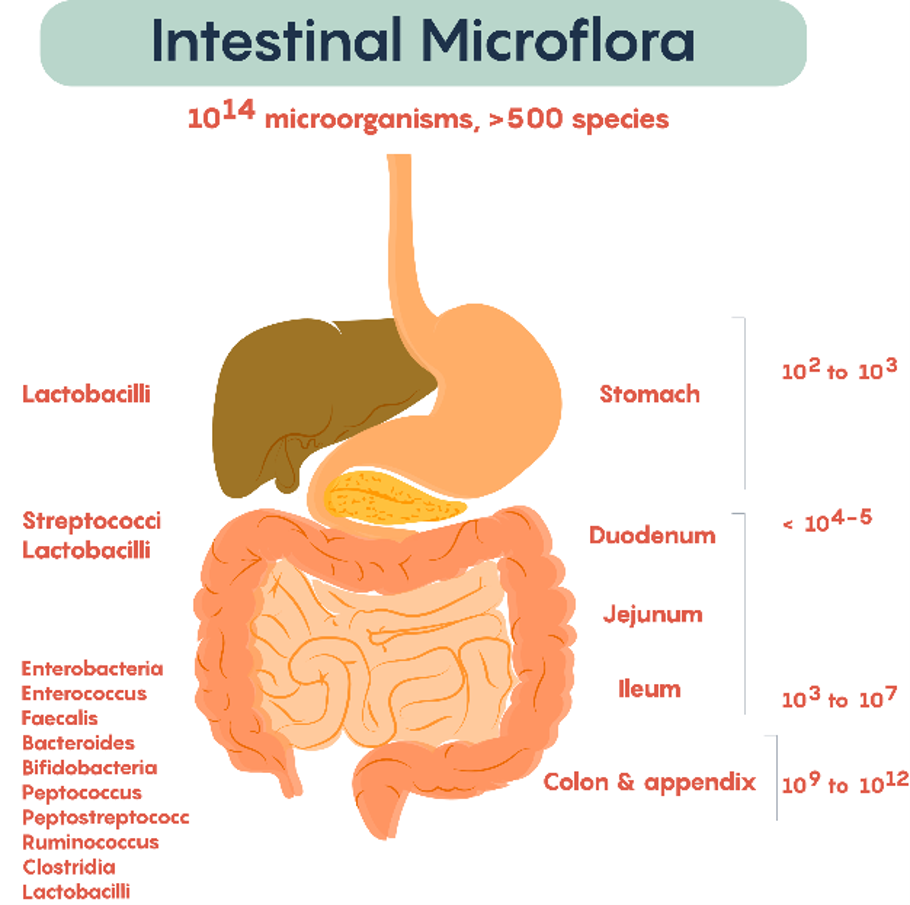
Courtesy of Dr William Ju, University of Toronto from http://neuroscience.openetext.utoronto.ca/chapter/chapter-1-the-gut-microbiome-and-its-impact-on-the-brain/
The density and complexity of the gut microbial population vary along the gastrointestinal tract as food progresses from the stomach to the large intestine (Figure 1). In the stomach and small intestine—including the duodenum, jejunum, and ileum—bacterial proliferation is constrained by multiple factors, including high acidity, oxygen exposure, antimicrobial compounds, and rapid transit time (Ju, W., 2020). As a result, only fast-growing organisms known as facultative anaerobes, which can survive with or without oxygen, are able to thrive there. These include Proteobacteria, Streptococci, and Lactobacilli. Their populations can range from about 100 (10²) to 10 million (10⁷) and generally increase as they move farther down the gastrointestinal tract (Kamada, N., 2013; Sekirov, I. et al., 2010). From the ileum into the large intestine and colon, the gut contains a much denser and more diverse community of beneficial anaerobic bacteria—organisms that live without oxygen. These bacteria, including Bacteroidales and Clostridiales, produce enzymes that break down complex carbohydrates, or polysaccharides, that were not digested in the small intestine, using them as a source of energy (Pickard, J.M. et al., 2017).
Beneficial symbiotic or commensal bacteria, also known as probiotics:
Although the digestive system is highly complex, gut health depends largely on a balanced, symbiotic relationship between the gut microbiota and the environment in which it lives. The body provides the conditions bacteria need to grow and survive, including moisture, temperature, pH, and essential nutrients (Breton, J., 2019). In return, symbiotic or commensal—meaning resident—bacteria help the intestinal immune system develop and mature, support the proper use and absorption of nutrients, and protect the gut from harmful pathogenic bacteria. They do this through competitive exclusion, also called colonization resistance, and by helping maintain a protective mucus barrier (Batt, R.M. et al., 1996). The term “probiotic” refers to these beneficial symbiotic bacteria. Common examples include Lactobacillus spp. and Bifidobacteria spp. Lactobacillus acidophilus is one familiar probiotic associated with lactic acid bacteria, which occur naturally in flour and are active in fermented sourdough starter cultures.
Harmful pathogenic bacteria:
When highly processed foods, sugar, and simple carbohydrates such as refined flour reach the colon, they can feed harmful pathogenic bacteria and encourage them to grow. These bacteria may include pathogenic E. coli (Delmas, J. et al., 2015), Salmonella (Jacobson, A. et al., 2018), Clostridium difficile, and Helicobacter pylori (Khalifa, M.M. et al., 2010). As they multiply, these organisms compete for nutrients in the large intestine and colon. They can also trigger inflammation, which may reduce how well nutrients are absorbed in the small intestine. Food particles that are not fully digested or absorbed can then pass into the colon, where they provide more fuel for harmful anaerobic bacteria (Thursby, E. and Juge, N., 2017). This competition may start in the small intestine, especially in the duodenum and jejunum, but it can continue throughout the intestinal tract and contribute to inflammation in the colon, known as colitis. Fortunately, the body has natural defenses that help limit this process. Pancreatic enzymes, such as amylase, help break down carbohydrates, while brush border enzymes produced by cells in the intestinal villi continue breaking down undigested food particles. By reducing the food available to pathogenic bacteria, these enzymes help create conditions that favor beneficial symbiotic microbiota (Hooton, D. et al., 2015).
Prebiotics: Nutritional substrates for beneficial bacteria
Prebiotics are “good” foods that support the growth and health of beneficial gut bacteria. These complex carbohydrates—resistant soluble fiber and starch—are found mainly in whole grain flours. Whole grain bran fiber, including arabinoxylan, fructan, inulin, and β-glucan, provides both soluble and insoluble fiber (Adam-Perrot A. et al., 2009). Sourdough Heaven uses Bay State Milling’s HealthSense™ High Fiber Wheat Flour, which contains 10 times more soluble resistant starch, or amylose, than common refined white flours. Because resistant fiber is not broken down by digestive enzymes in the stomach or small intestine, it reaches the colon, where beneficial bacteria ferment it.
Partial baking and freezing whole grain bread can also increase resistant fiber and starch through retrogradation. This process occurs when starches such as amylose and amylopectin change structure during heating and then reform as resistant starch when cooled (Arp, C. G. et al, 2020). Together, higher amylose content, HealthSense™ High Fiber Wheat Flour, partial baking, and freezing help increase resistant starch while reducing bread staling and firming during storage.
Postbiotics: Metabolites produced by beneficial bacteria
Once the prebiotic fiber is in the lower gut, it is fermented (digested) by the “good” symbiotic bacteria. This microbial fermentation process produces metabolites called short chain fatty acids “SCFA”. Examples of SCFA are acetate, propionate, and butyrate. SCFA are an important energy source for the intestinal epithelial cells and contribute to the strengthening of the gut mucosal barrier function. They also protect the gut by regulating pH and oxygen concentration, thus creating a less favorable environment for pathogen growth (Blaak, E.E. et al., 2020).
How does Sourdough Heaven bread support gut health?
Sourdough Heaven bread is made with carefully selected organic flours, including ancient, heirloom, modern, and sprouted whole grains. These flours provide prebiotic fiber that nourishes beneficial gut bacteria and supports digestion (Slavin, J.L., 2003). During fermentation, a starter made from organic whole-grain rye, spelt, and wheat promotes helpful yeast and lactic acid bacteria, which produce natural acids, lower pH, activate enzymes, and help break down starches, proteins, and phytic acid. This process releases nutrients and beneficial compounds that support gut bacteria, the intestinal lining, and nutrient absorption. Partial baking and freezing also improves the bread’s structure by reducing staling and firming during storage, while increasing the amount of resistant starch (Arp, C. G. et al, 2020).
References:
Adam-Perrot A. et al. (2009) Resistant Starch and Starch-Derived Oligosaccharides as Prebiotics. In: Charalampopoulos D., Rastall R.A. (eds) Prebiotics and Probiotics Science and Technology. Springer, New York, NY.
Arp, C. G., Correa, M.J., and Ferrero, C., (2020), Kinetic study of staling in breads with high-amylose resistant starch, Food Hydrocolloids, Volume 106, 2020, 105879, ISSN 0268-005X, https://doi.org/10.1016/j.foodhyd.2020.105879.
Backhed, F., 2005, Host-bacterial mutualism in the human intestine. Science 307, 1915–1920 doi:10.1126/science.1104816.
Batt, R.M. et al., 1996, Enteric bacteria: friend or foe? J Small Anim Pract. 1996 Jun;37(6):261-7. doi: 10.1111/j.1748-5827. 1996.tb02376.x. PMID: 8805096.
Blaak, E.E. et al., 2020, Short chain fatty acids in human gut and metabolic health. Benef Microbes. 2020 Sep 1;11(5):411-455. doi: 10.3920/BM2020.0057. Epub 2020 Aug 31. PMID: 32865024.
Breton, J., 2019, The gut microbiota: a symbiotic relationship with humans, Microbiome Foundation.
Brody, J. E., 2014, Blog - We Are Our Bacteria, New York Times, New York edition, 07/15/2014, Well, Personal Health, page D7 under the headline: A Body’s Bacterial Companions.
Delmas, J. et al., 2015, Escherichia coli: The Good, the Bad and the Ugly, Microbes, Intestine, Inflammation and Host Susceptibility, INSERM U1071, INRA USC2018, ,Université Clermont Auvergne, Clermont-Ferrand, France.
Hooton, D. et al., 2015, The Secretion and Action of Brush Border Enzymes in the Mammalian Small Intestine, Rev Physiol Biochem Pharmacol. Pages 168:59-118. doi: 10.1007/112.
Jacobson, A. et al., 2018, A Gut Commensal-Produced Metabolite Mediates Colonization Resistance to Salmonella Infection, Cell Host & Microbe, Vol. 24, 296–307.
Ju, W., 2020, Microbial density in the gut, The Gut Microbiome and its Impact on the Brain, Retrieved April 6, 2021.
Kamada, N. et al., 2013, Role of the gut microbiota in immunity and inflammatory disease. Nat Rev Immunol. 2013;13:321–335.
Khalifa, M.M. et al., 2010, Helicobacter pylori: a poor man's gut pathogen? Gut Pathog. 2010 Mar 31;2(1):2. doi: 10.1186/1757-4749-2-2. PMID: 20356368; PMCID: PMC2861632.
Lozupone, C.A. et al., 2012, Diversity, stability and resilience of the human gut microbiota. Nature. 2012;489(7415):220-230. doi:10.1038/nature11550.
Pickard, J.M. et al., 2017, Gut microbiota: Role in pathogen colonization, immune responses, and inflammatory disease. Immunol Rev. 2017;279(1):70-89. doi:10.1111/imr.12567.
Sekirov, I. et al., 2010, Gut microbiota in health and disease. Physiol. Rev. 2010, 90, 859–904.
Sharma, R. et al., 2014, Probiotic Efficacy and Potential of Streptococcus thermophilus modulating human health: A synoptic review. IOSR Journal of Pharmacy and Biological Sciences. 9. 2319-7676. 10.9790/3008-09325258.
Slavin, J.L., 2003, Why whole grains are protective: biological mechanisms, Proceedings of the Nutrition Society (2003), 62, 129–134 DOI:10.1079/PNS2002221.
Thursby E and Juge N., 2017, Introduction to the human gut microbiota. Biochem J. 2017;474(11):1823-1836. doi:10.1042/BCJ20160510.
Valdes, A. M. et al., 2018, Role of the gut microbiota in nutrition and health, BMJ 2018; 361 :k2179.