Understanding the Stability and Room-Temperature Shelf Life of sourdough heaven bread
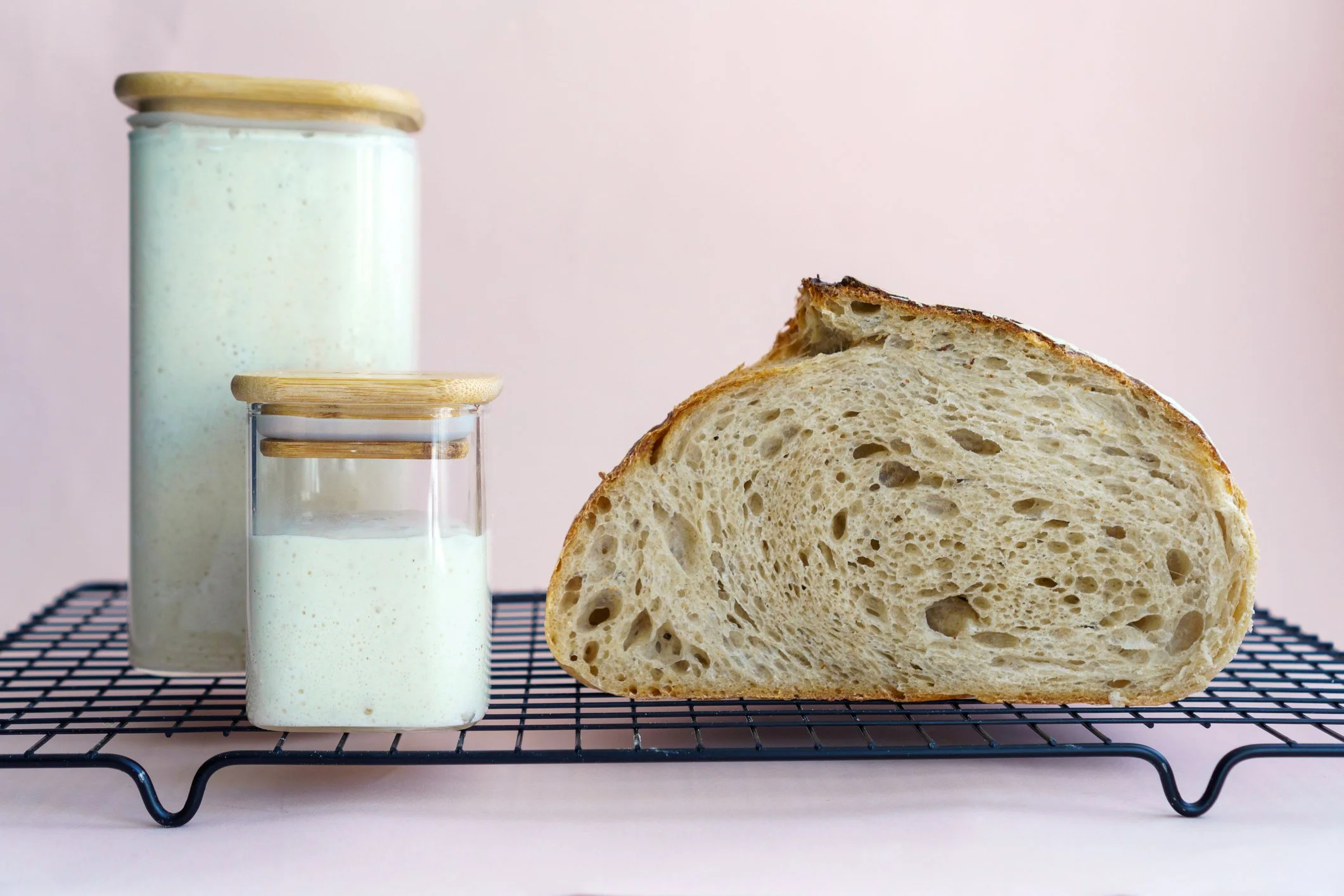
Lactic acid bacteria play a major preservative role in extending the stability and shelf-life of sourdough bread.
Abstract
This pilot study evaluated the room-temperature shelf life of sourdough bread produced using four preservation approaches: sourdough alone (SB0), sourdough supplemented with calcium propionate (SBCP), and sourdough supplemented with two concentrations of Lactiplantibacillus plantarum (SB1 and SB2). Four loaves were produced using a common dough formulation and monitored for pH, loaf characteristics, and visible mold development during storage. Under storage conditions of approximately 72–73°F and 45% relative humidity in open plastic bags, no visible mold was observed on SB0 or SBCP through Day 10, while limited mold development was observed on SB1 and SB2 by Day 5. Because only one loaf was evaluated per treatment and no microbiological analyses were performed, the findings should be considered preliminary observations. The results suggest that traditional sourdough fermentation alone may provide substantial antifungal activity under low-humidity storage conditions.
Keywords
Sourdough, biopreservation, Lactiplantibacillus plantarum, calcium propionate, shelf life, mold inhibition, lactic acid bacteria
Introduction:
“Biopreservation relies on the natural antimicrobial properties of food microorganisms and the compounds they produce to extend shelf life and preserve food quality over time [García, P. et al., 2020]”. A well-known example is sourdough fermentation, where microbial byproducts enhance bread’s flavor, aroma, texture, digestibility, nutritional value, and preservation. In sourdough, lactic acid bacteria (LAB) play a major preservative role through the production of antimicrobial substances, including organic acids and phenolic compounds [Bartkiene, E. et al., 2020]”.
Mold grows slowly on bread and generally will not develop when ambient relative humidity stays below 90%. However, in moist environments, particularly inside wrapped loaves, mold can spread quickly. The speed of mold growth is affected by multiple factors, including the flour type, production process, packaging method, and storage conditions [Pateras, I.M.C., 1998].
“LAB can prevent mold or fungal growth through three main functions. First, it produces antimicrobial substances such as lactic acid, phenolic acids, hydrogen peroxide, short-chain organic acids, and bioactive peptides. Second, LAB competes effectively for nutrients within the growth substrate, limiting resources available to fungi. Third, the fermentation process lowers the pH of the environment, creating an acidic environment that inhibits fungal growth and survival [Dalié, D.K.D. et al., 2010]”.
Objectives:
Determine the stability and room-temperature shelf life of Sourdough Heaven bread when using different preservation methods, including a chemical preservative (calcium propionate) and biological supplementation with freeze-dried Lactiplantibacillus plantarum (formerly Lactobacillus plantarum). This pilot study was based on a trial protocol, used by the Department of Food Science and Toxicology, Faculty of Pharmacy, University of Valencia, described in MDPI science publication, Foods 2023, 12, 864, Bread Biopreservation through the Addition of Lactic Acid Bacteria in Sourdough. https://doi.org/10.3390/foods12040864, (Illueca, F. et al, 2023), in Table 1:
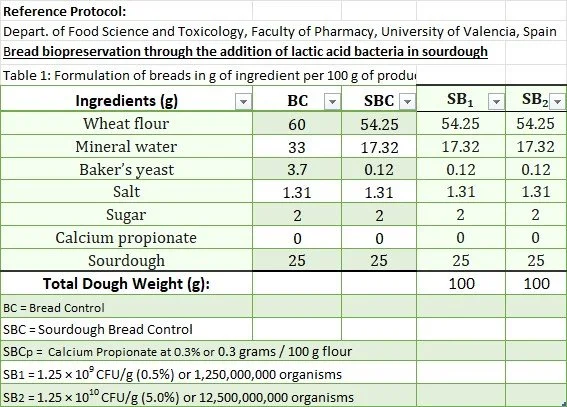
Illueca, F. et al, 2023, Foods 2023, 12, 864, Bread Biopreservation through the Addition of Lactic Acid Bacteria in Sourdough.
Materials and Methods:
The effect of sourdough, alone or with chemical or biological preservatives was examined on properties of the dough during fermentation and after final baking. Three parameters were evaluated: pH, volume increase and visible signs of mold or fungus.
Each loaf contained approximately 405 g of total flour (298 g blend + 107 g levain 50% flour) and weighed approximately 800 g after mixing.
Four treatments were prepared: SB0 (negative control - sourdough starter/levain only), SBCP (calcium propionate- 0.3% or 1.25 g/ 405 g of flour weight), SB1 (0.125 g or 12.5 billion CFU L. plantarum / 405 g of flour weight), and SB2 (0.50 g or 50 billion CFU L. plantarum / 405 g of flour weight). The Lactobacillus Plantarum probiotic was supplied by Vitamatic - Proempire LLC, Table 2.
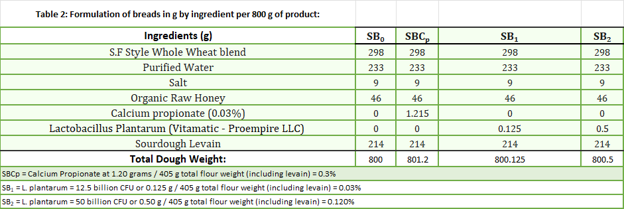
Adapted from trial protocol, used by the Department of Food Science and Toxicology, Faculty of Pharmacy, University of Valencia, Spain
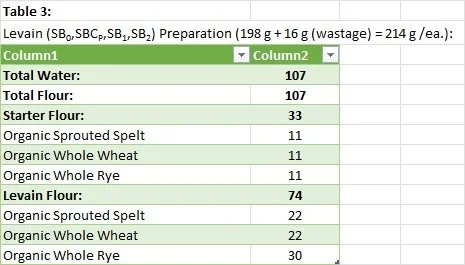
Both sourdough starter and levain consisted of organic sprouted spelt, organic whole wheat and organic rye flours. Levains were prepared using 74 g water, 66 g mature starter (33 g flour + 33 g water), and 74 g flour. Each levain was fermented at approximately 80°F until doubled in volume, Table 3.
The final dough formula utilized the original Sourdough Heaven San Francisco Style Whole Wheat formulation described in the Baker’s Percentage Formula, Table 4.

Note: This Baker’s Percentage Formula uses a high levain content (70%) of total flour weight (214 g / 298 g) in the final dough. It also has a hydration rate of 84%. Experience has shown that a whole grain levain generally shortens the fermentation time and improves the acidic quality of sourdough. It also results in a moist and dense crumb texture and thicker crust, with an acceptable baking volume quality.
Results:
After the bread was baked, it was allowed to cool on racks, at room temperature. The loaves were left on a kitchen countertop. Storage conditions were approximately 72–73°F and 45% relative humidity. Bread was stored in open plastic bags (2 mil thickness) to permit air exchange while limiting excessive moisture loss.
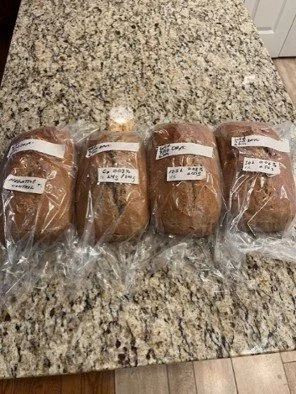
Image 1: Bread placed in plastic storage bags at day 1.
In studies such as (Sanz-Penella et al, 2012), a lower post-fermentation volume was experienced using a sourdough inoculum of 20%. In contrast, in this study, incorporating a higher amount of levain (70%) had a positive influence on all four loaves, following a 3 hour of fermentation period at 78°F, showing no significant differences in volume between all four loaves, despite the Lactobacillus plantarum in breads SB1 and SB2. As typically experienced with all Sourdough Heaven bread, the amount of sourdough levain and the time of fermentation directly influences the dough volume.
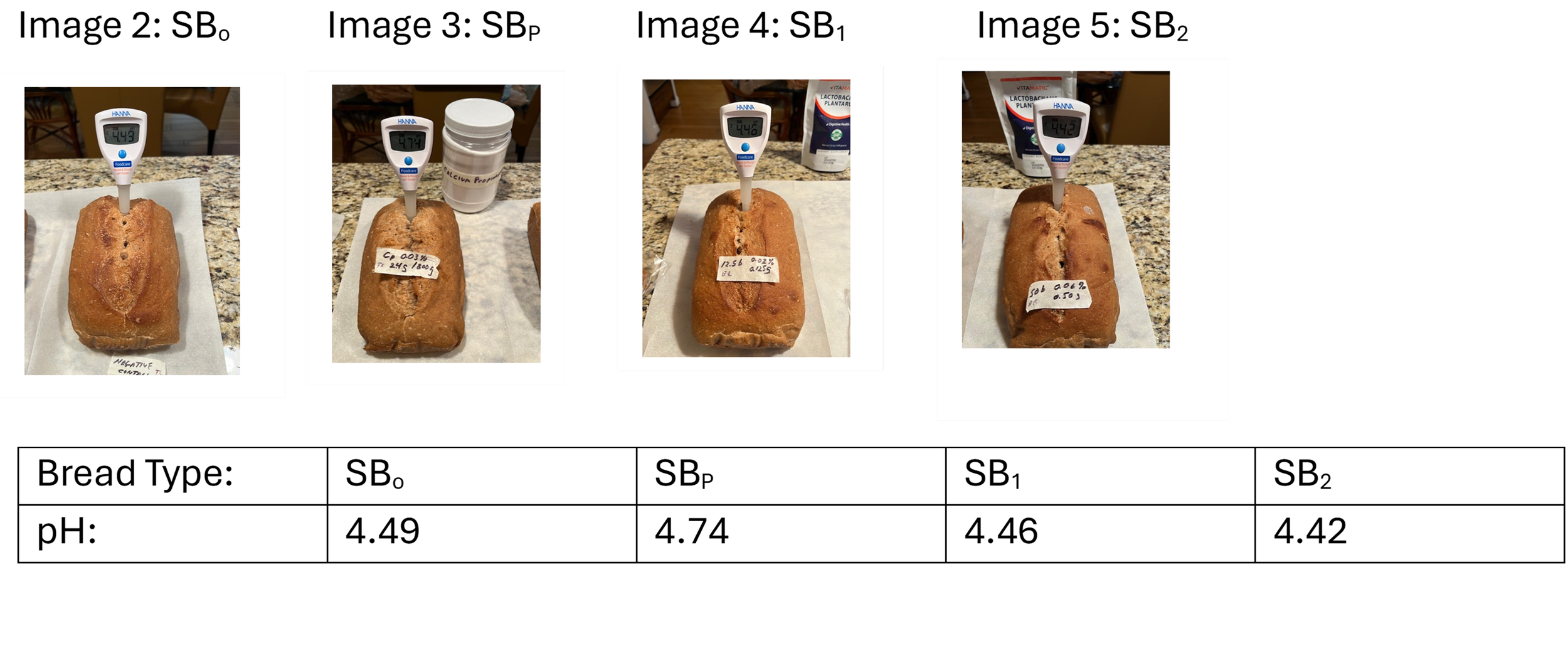
Day 5, pH and visual inspection:
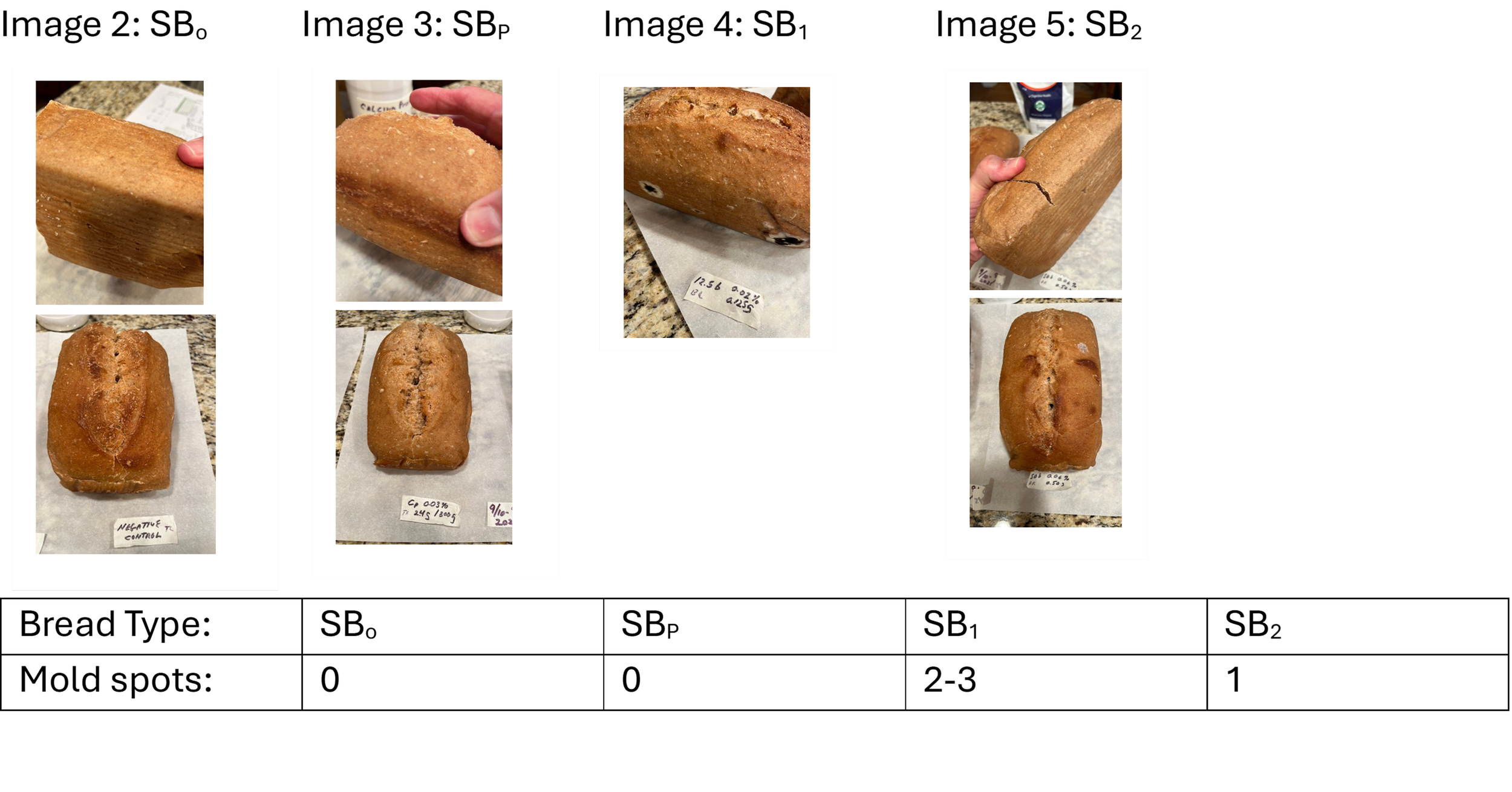
Results: Day 5 mold appearance:
Day 5 results showed the following:
1. No volume changes were noted. All 4 x 800 g bread samples showed similar baking quality.
2. Very slight pH difference between all four loaves, suggesting that adding the LAB probiotic did not have any meaningful impact on the pH levels.
3. Bread samples SB0 (Negative Control) and SBP (Calcium Propionate) showed no signs of molding through day 10:
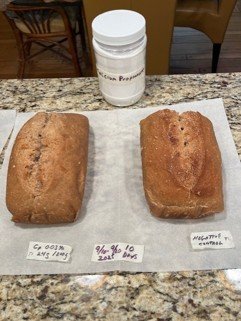
Day 10: SBP (CP - left) and SB0 (NC -right)
The relatively small differences in pH suggest that supplementation with the L. plantarum probiotic did not substantially alter final bread acidity under the conditions tested.
Discussion:
The right conditions are necessary for bread mold growth. “Bread that is sliced, prepackaged or wrapped loaves are prone to mold spoilage. This occurs when ambient relative humidity (RH) is above 60%, the bread moisture level, expressed as “active water- aw (available or free water) is between 0.94 and 0.97, along with a pH of 6 [Magan, N., et al. 2003a].” A storage or environment temperature needed to promote mold growth is storage temperatures between 25–30 ◦C, or ≥ 77°F. Bread wrapping conditions will also impact mold growth. Storing bread in an unbreathable plastic bag, retaining moisture and air circulation, will promote mold growth. The opposite is true with paper bags. In this trial, the ambient conditions of this trial were less favorable for mold growth, 45% RH and 73°F. However, the four bread samples were stored in open (unsealed) plastic storage bags for the 10 day duration of the trial.
Both the Negative Control SB0 and Calcium Propionate (CP) SBP, samples A and B, demonstrated total absence of mold growth through day 10.
The uninoculated Negative Control SB0, bread sample (A), had a pH of 4.43 at day 5 which may have been sufficiently low to prevent molding in the absence of supplementing 1.25 × 10¹⁰ CFU or 5 × 10¹⁰ CFU of probiotic L. plantarum powder. The composition of the levain and amount used may account for this due to the variety of whole grain flours (rye, spelt, whole wheat, sprouted hard red winter wheat and yecora rojo). Other flours included HealthSense™ (high amylose starch flour) and organic high protein (12.7%) bread flour which contributed to gluten strength, volume increase and moisture retention.
In the case of the CP SBP bread sample B, a higher inclusion level of 0.3% (in a recommended range of 0.1%-0.3%) and pH of 4.74 (day 5). In a 2004 in-vitro study by Suhr and Nielsen, they showed that a “high 0.3% propionate concentration generally had a strong inhibitory effect on all fungi tested at pH 4.5 and aw 0.95, but not at pH 6, which is generally the pH of standard wheat bread. [Suhr, K. I. and Nielsen, P. V, 2004]” This result would fall in line with their conclusions.
Maintaining the right balance of lactobacillus organisms is also very important. Too high a concentration of L. plantarum could potentially destabilize the microbial balance of other lactobacillus organisms that provide a broader anti-fungal system found in traditional sourdough cultures [Zielinska, D.; Kostrzewska, A, 2024]. The University of Valencia study used two dosages of L. plantarum, 1.25 × 10⁹ CFU/g (0.5%) or 1,250,000,000 organisms and 1.25 × 10¹⁰ CFU/g (5.0%) or 12,500,000,000 organisms. In our trial, we used a much higher level of 5.00 × 10¹⁰ CFU/g or 50,000,000,000 organisms.
L. plantarum is a facultatively heterofermentative organism meaning that it produces only lactic acid as a primary by-product. Lactic acid increases acidity by lowering the pH. L. plantarum can produce acetic acid, ethanol and CO2 when under stressful conditions (lack of food source; i.e., glucose and maltose). Lactobacillus sanfranciscensis (including L. fermentum and L. brevis) are mostly present in natural starter cultures using commonly commercialized and distributed flours. They are called obligately heterofermentative organisms and produce lactic acid, acetic acid, phenyllactic acid (PLA), ethanol and CO2 [Ventimiglia, G et al., 2015]. The dosage rates used (dose relative to the flour) of 1.25 × 10¹⁰ CFU or 5 × 10¹⁰ CFU of probiotic L. plantarum powder may have been excessive, disrupting the existing sourdough microbiome balance found in the natural levain. This may also account for the reason why Negative Control, sample A, outperformed the probiotic treated samples C and D.
In addition, a lower pH alone does not necessarily guarantee better shelf life. Bread with high lactic acid and low acetic acid can mold faster than bread with slightly higher pH but stronger antifungal metabolite production (phenyl derivatives, fatty acids, peptides and bacteriocins).
Conclusion:
Several factors may explain the observed outcomes. The sourdough control exhibited strong resistance to visible mold development, suggesting that the native sourdough microbiota and metabolites provided meaningful antifungal activity. The combination of whole-grain flour diversity, relatively high levain inclusion, and low final pH likely contributed to preservation.
The calcium propionate treatment performed consistently with published literature demonstrating effective inhibition of bread spoilage fungi under acidic conditions.
Visible mold appeared earlier on probiotic-treated loaves than on the sourdough control. However, because microbial populations, metabolite concentrations, and water activity were not measured, the study cannot determine the mechanism responsible. Any explanation involving alteration of the sourdough microbial ecosystem remains speculative.
The results were interesting but inconclusive given the points brought up in the discussion above. A repeat of this trial would be needed, adjusting the probiotic dosage levels and ambient conditions more in line with the University of Valencia study referenced above.
In addition, because only one loaf was evaluated per treatment and no microbiological analyses were performed, these findings should be considered preliminary. Additional replicated research is required before definitive conclusions can be drawn regarding probiotic supplementation as a bread biopreservation strategy.
References:
Pilar García, Lorena Rodríguez, Ana Rodríguez, Beatriz Martínez, Food biopreservation: promising strategies using bacteriocins, bacteriophages and endolysins, Trends in Food Science & Technology, Volume 21, Issue 8, 2010, Pages 373-382, ISSN 0924-2244, https://doi.org/10.1016/j.tifs.2010.04.010, https://www.sciencedirect.com/science/article/pii/S0924224410001275
Bartkiene E, Lele V, Ruzauskas M, Domig KJ, Starkute V, Zavistanaviciute P, Bartkevics V, Pugajeva I, Klupsaite D, Juodeikiene G, et al., 2020, Lactic Acid Bacteria Isolation from Spontaneous Sourdough and Their Characterization Including Antimicrobial and Antifungal Properties Evaluation. Microorganisms. 2020; 8(1):64. https://doi.org/10.3390/microorganisms8010064
Pateras, I.M.C., 1998, Bread spoilage and staling. In Technology of Breadmaking, Springer: New York, NY, USA, pp. 240–261, ISBN 978-1-4613-5922-7.
Dalié, D.K.D., Deschamps, A.M., Richard-Forget, F., 2010, Lactic acid bacteria – Potential for control of mould growth and mycotoxins: A review,Food Control, Volume 21, Issue 4, 2010, Pages 370-380, ISSN 0956-7135, https://doi.org/10.1016/j.foodcont.2009.07.011, https://www.sciencedirect.com/science/article/pii/S0956713509002229
Illueca, F., Moreno, A., Calpe, J., Nazareth, T.d.M., Dopazo, V., Meca, G., Quiles, J.M., Luz, C., 2023, Bread Biopreservation through the Addition of Lactic Acid Bacteria in Sourdough. MDPI Foods 2023, 12, 864, https://doi.org/10.3390/foods12040864
Sanz-Penella, J.M.; Tamayo-Ramos, J.A.; Haros, M., 2012, Application of Bifidobacteria as Starter Culture in Whole Wheat Sourdough Breadmaking. Food Bioproc. Technol. 2012, 5, 2370–2380.
Axel, C.; Zannini, E.; Arendt, E.K., 2027, Mold spoilage of bread and its biopreservation: A review of current strategies for bread shelf-life extension. Crit. Rev. Food Sci. Nutr. 2017, 57, 3528–3542.
Magan N., Arroyo, M. and Aldred, D., 2003a, 24 - Mould prevention in bread. In: Bread Making, Woodhead Publishing Series in Food Science, Technology and Nutrition, pp. 482–494, Cauvain, S. P. Ed., Woodhead Publishing. doi:https://doi.org/10.1533/9781855737129.2.500
Suhr, K. I. and Nielsen, P. V, 2004, Effect of weak acid preservatives on growth of bakery product spoilage fungi at different water activities and pH values, Int. J. Food Microbiol. 95:67–78. doi:10.1016/j. ijfoodmicro.2004.02.004
Zielinska, D.; Kostrzewska, A, 2024, Development of Sourdough Bread Madewith Probiotic Lactiplantibacillus plantarum Bacteria Addition, Appl. Sci. 2024, 14, 6155. https://doi.org/10.3390/app14146155
Ventimiglia, G., Alfonzo, A., Galluzzo, P., Corona, O., Francesca, N., Caracappa, S., Moschetti, G., Settanni, L., 2015, Codominance of Lactobacillus plantarum and obligate heterofermentative lactic acid bacteria during sourdough fermentation, Food Microbiology, Volume 51, 2015, Pages 57-68, ISSN 0740-0020, https://doi.org/10.1016/j.fm.2015.04.01